Distributed critical infrastructure

Maintenance for infrastructure that is rarely staffed on site.

Solar sites, battery storage, and critical facilities are maintained by contractors and subcontractors across locations that are often unattended. Completing the work is only part of the task; the record must also demonstrate that it was done.

The problem

Subcontractors rarely use a client CMMS.

Few contractors will create an account, install an app, and complete onboarding for a single job. The work therefore takes place outside the maintenance system and returns as photographs in a WhatsApp thread.

That arrangement becomes a problem when an asset owner disputes a response time or an auditor requests twelve months of preventive-maintenance records. The evidence may be buried in a chat history, or may never have been captured.

Per-seat licensing is often what prevents field work from reaching the system of record.

Operational consequences
SLA disputes
Penalties are difficult to challenge when the required timestamp cannot be produced.
Owner reporting
Reports for each asset owner are assembled manually from incomplete records.
Audits
Preventive-maintenance history must be rebuilt from contractor PDFs.
Warranty
Claimable failures can be missed when a fault is not linked to the asset record.
Renewals
Work completed over the contract term is difficult to demonstrate.
How it works

How a subcontractor completes a work order

A subcontractor receives a link to the work order, completes the checklist, and attaches photographs. No licence, app, or account is required. The completed work returns as a structured record against the asset.

facterra.app/wo/8841-k2f9
Work order · WO-8841
Quarterly inverter service
INV-B02-014 · Redland Creek I
3 of 4 completeStarted 13:48
Visual inspection — enclosure, seals, cable entries14:02
Torque check on DC terminations14:09 · 12 readings
Clean filters, record differential pressure14:17 · ΔP 0.4 kPa
Thermal scan — record hotspots
14:02
14:17
Complete & sign off
No login required
01 · Assign
Create the work order against the asset and assign it to a subcontractor, whether an individual or a firm, with the scope, evidence requirements, and deadline attached.
02 · Send
Send a link by SMS or email. It opens on any phone, with no licence, installation, or account required.
03 · Execute
The contractor can review the asset, its history, the documentation, and the checklist before completing the job.
04 · Capture
Photographs, readings, timestamps, and sign-off are captured at the point of work rather than reconstructed later.
05 · Prove
The record is held against the asset in your system, ready when an owner queries an SLA or an auditor requests it.
Introducing Facterra

What Facterra does

For employees and subcontractors

Licence-free mobile work orders for employees, subcontractors, and third-party crews. When a provider delegates work to another subcontractor, the chain remains visible, showing who completed the work as well as who submitted the invoice.

A record that supports review

Each work order creates an audit trail of photographs, readings, timestamps, checklists, and sign-off. Evidence packs for asset owners and auditors are produced from the information captured when the job closes.

Portfolio management without unnecessary overhead

Manage an asset hierarchy across hundreds of sites and multiple owners, pool spare parts across locations, schedule preventive maintenance by runtime, and integrate with ERP, MES, and SCADA systems. Facterra runs in our cloud or on your own servers and can go live in weeks.

The board

Every site, owner, and crew in one view

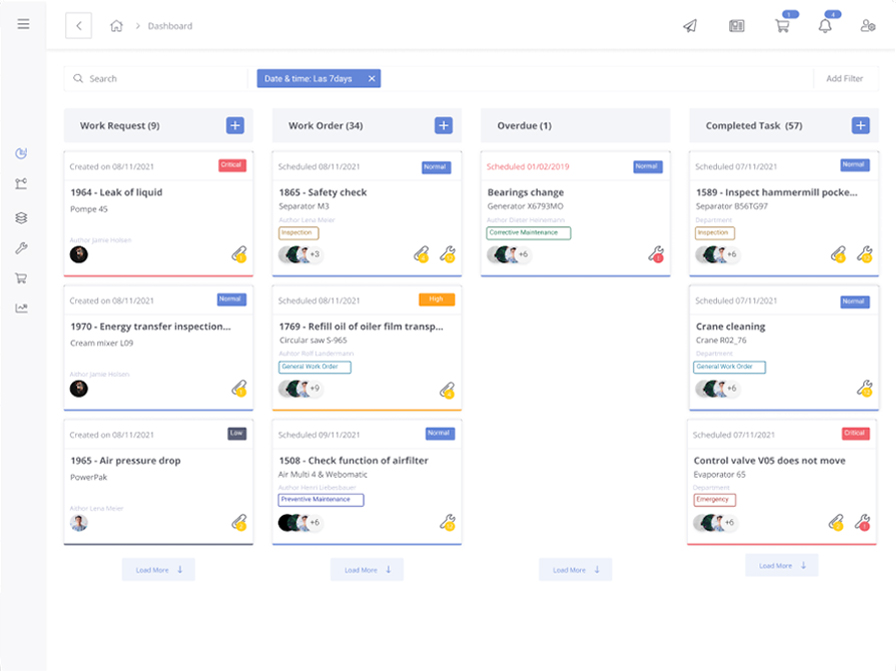
See requests, scheduled work, overdue tasks, and completed work across every site you maintain, together with the owner and crew assigned to each job.

The Facterra maintenance board: four columns headed Work Request, Work Order, Overdue and Completed Task, each holding cards that show the scheduled date, priority, asset, work type and the crew assigned.

The Facterra maintenance board, showing requests, scheduled work, overdue tasks, completed work, and assigned crews.

The output

Most systems record that a job closed, rather than what was done to the asset.

Facterra captures the supporting evidence as jobs close, including certificates, readings, signatures, and photographs. The evidence pack is therefore available when an asset owner disputes an SLA or an auditor requests it.

Facterra does not create missing evidence. A missing signature remains visible, allowing the team to address the gap.

Reporting › Evidence packExport PDF
Q2 2026 — Meridian Renewables Fund
4 sites · 01 Apr – 30 Jun 2026
SLA met
142
PM complete
98.6%
On schedule
31
Corrective
486
Photos
Work orderAssetClosedEvidence captured
Quarterly inverter service
WO-8612
INV-B02-014 12 Jun
A. Whitcombe · SUB
6 photos4 readingsSignature
14:22 · geotagged
Thermography — combiners
WO-8571
Block A–D 04 Jun
J. Moreau
IR report28 scansSignature
09:05 · geotagged
MV switchgear inspection
WO-8498
SWG-01 22 May
E. Kowalski · SUB
Certificate3 photosNo signature
11:47 · geotagged
Module cleaning — Block C
WO-8455
SITE-KR2 15 May
R. Halvorsen · SUB
12 photosBefore/afterSignature
16:30 · geotagged
1 gap: WO-8498 closed without signature Compiled 01 Jul 2026 · 09:14

Interface mockup — representative data, not a customer record.

Where we sit

How Facterra compares with common alternatives

 Asset depthSpeed & costField execution
Maximo, SAP PM, InforDeep12–18 months, enterprise pricePer-seat, weak mobile
Limble, UpKeep, MaintainXSingle-buildingInstant, cheapPer-seat, app + onboarding
Monitoring platformsPerformance, not maintenanceNot their job
FacterraFull hierarchy, multi-siteWeeksLicence-free links

Maximo's asset model, without Maximo's cost or implementation timeline.

How it fits your stack

Facterra holds the record and shares the data.

Facterra is designed to sit within an existing technology stack, rather than replace it. It holds the asset, work, parts, and evidence records, and its API allows connected systems to access the information they require.

Scheduling is one example. Facterra integrates Timefold's optimisation engine. Crews, skills, parts, permits, and production windows inform a schedule that is then managed in the same application as the work itself.

Scheduling
Timefold's optimisation API accounts for crews, skills, routes, and shifts, rather than relying on a rules-of-thumb schedule.
Monitoring & SCADA
Continue using Power Factors, Prescinto, AlsoEnergy, or an OEM portal. Alarms can create work orders in Facterra.
ERP
Spare parts stock, purchase orders, single sign-on.
IoT & meters
Sensors, meters, and counters support runtime-based maintenance, as they have in industrial deployments since 2017.
BMS & DCIM
Facterra manages plant maintenance while DCIM manages capacity. Most operators use both.
Where this came from

Eight years of use in demanding industrial environments

Facterra has managed industrial assets since 2017 and has been deployed at more than 50 facilities across North America, Europe, and Asia, including dairies, breweries, steel plants, water-treatment sites, and an ethanol producer.

These are environments with demanding equipment, variable connectivity, and technicians who have little time for another application.

The asset model applies across industries. A string inverter on a preventive-maintenance schedule, under warranty, with an owner requesting proof of service has the same underlying record requirements as a homogeniser in a dairy. Distributed infrastructure differs because the site is unmanned and the technician is usually a subcontractor.

50+
Facilities
Industrial deployments since 2017.
2K+
Machines
Connected with meters and counters.
3
Continents
North America, Europe and Asia.
Industrial deployments, 2017–present · Read the customer stories →
Kaufland Molkerei Rücker Prairie AquaTech Ovomaltine Aquatech Adkins Energy Ballast Point

“The tracking of activities in case of an audit, both internal and external — all information is easy to extract. You can look at the history of each piece of equipment, tracing all the activities that have been done on it.”

Dustin Gibbons — Production Manager, Prairie AquaTech

“It is clearer to have everything in one programme than to open three different things. And especially with machines, you want to have a history.”

Jörn Möller — Leiter Technische Werkstatt, Molkerei Rücker

Roadmap

Taking the paperwork off your technicians

Technicians spend much of their day on administrative work rather than on tools. We are building an EAM to help with that work: raising orders, suggesting causes, coordinating parts, and assembling evidence.

The system can suggest; a named person remains responsible for sign-off.

Escalates uncertainty
It does not guess torque figures or isolation steps. Low-confidence outputs are referred to a person.
Does not sign
Permits, isolations, pressure systems, and other activities carrying a regulatory signature require a named person's approval.
Traceable outputs
Each figure links to the reading, document, or transaction that supports it. Unsourced figures are not presented as fact.
Measured performance
Its performance is reported through a scorecard rather than asserted in marketing material.
FAQ

Common questions

What is Facterra?

Facterra is an enterprise asset management system for maintenance and compliance execution in distributed critical infrastructure. It is designed for organisations maintaining assets across sites they neither own nor staff directly, including renewable-energy O&M contractors managing solar, wind, and storage portfolios, and teams responsible for critical facilities such as data centres. It manages work execution, subcontractor dispatch, and the evidence required by asset owners and regulators.

How is Facterra different from a traditional CMMS or EAM?

Traditional CMMS and EAM systems generally assume that work is completed by employees with named licences. In distributed infrastructure, much of the work is completed by subcontractors, so records often remain in WhatsApp messages, spreadsheets, and PDFs rather than in the maintenance system.

Facterra allows subcontractors to complete a work order from a link, without a licence, app, or account, so the record is captured where the work takes place. It also treats audit evidence as an output of completed work rather than a reporting exercise conducted later. Read more about subcontractor execution.

Do subcontractors need a licence, an account or an app?

No. A subcontractor receives a link, opens it on their phone, and completes the work order, including readings, photographs, parts used, and a signature. No licence, app, or account is required. Facterra is licensed as a platform rather than per seat, so the cost does not increase with the size of the contractor network.

Does Facterra work offline at sites with no connectivity?

Not yet. Offline capture is in active development and will not be represented as available before it ships. Remote solar farms, wind sites, and plant rooms frequently have limited or no usable signal, so please ask for the current delivery status when you speak with us.

Can Facterra run on our own servers?

Yes. Facterra can be deployed in your own cloud tenancy or on your own servers. This matters for data-centre operators and asset owners whose security review does not permit an external multi-tenant system. Vendor-hosted deployment is also available. See critical facilities.

What does an evidence pack contain?

An evidence pack brings together the work orders completed, the people who performed them and their certifications, timestamped readings and site photographs, parts consumed, and task signatures. Because it is generated from the work record rather than compiled manually, it can be produced on demand for an asset owner, auditor, or insurer.

Which assets and industries does Facterra cover?

Facterra covers renewable-energy generation, including solar PV trackers, inverters, and combiners, wind turbines, and battery energy storage, as well as mechanical and electrical plant in critical facilities, such as standby generators, UPS systems and battery strings, chillers, CRAC units, and switchgear. It has supported industrial maintenance since 2017 and is now applied to renewables O&M and critical facilities.

How long does a Facterra deployment take?

A deployment takes weeks rather than a year. It includes a discovery workshop, migration of the existing asset and maintenance data, integrations, and training. The work is led by the product team rather than an implementation partner, and we take on a limited number of concurrent deployments.

How much does Facterra cost?

Facterra is licensed as a platform rather than per seat, so the contractor network is not a separate line item and cost does not scale with the number of people who use a work order. Pricing depends on portfolio size and whether you self-host, and is quoted directly rather than published.
Working with us

How deployment works

We take on a limited number of deployments at a time and lead them directly.

How we work

Deployment includes data migration, integrations, and training. You work directly with the people who build the product, rather than through a support queue. Licensing is by platform, so the contractor network does not become a separate line item.

What it takes from you

We need a discovery workshop, access to the data you already hold, and a decision-maker who can commit. Go-live is measured in weeks rather than a year.

Facterra has supported industrial maintenance since 2017. We are now applying that experience to renewables O&M and critical facilities, while keeping the number of concurrent deployments limited because we lead them directly rather than handing them to an implementation partner.