For renewable energy O&M contractors

Sixty sites, twelve asset owners, and two hundred subcontractors you can't buy seats for.

Facterra is the work execution and evidence system for O&M contractors maintaining renewable assets they don't own.

The day

The morning starts before you do.

The morning starts with alarms from three monitoring platforms, a PM spreadsheet, and WhatsApp messages from four crews. You dispatch by phone. Evidence comes back as photos in a chat. Someone re-keys what they can.

At quarter end, assembling one asset owner's report takes days.

Then an owner disputes a response time on a critical repair, and you spend an afternoon scrolling chat history looking for a timestamp you're not sure exists.

The cause

The licensing model, not your process

Every CMMS on the market charges per seat and requires onboarding. You cannot buy two hundred seats for subcontractors who rotate constantly, and they won't complete an onboarding flow for a single job.

So field execution stays outside the system, and a maintenance system that doesn't contain the field work is an expensive way to keep a spreadsheet.

You end up paying per login for a system whose value depends on people who will never log in.

What Facterra does

What Facterra does for an O&M contractor

Subcontractors work from a link

No licence, no app, no account. Structured completion with photos, readings, timestamps and sign-off. When your provider delegates again to their own subcontractor, the chain stays visible to you.

Certificates checked before the gate

An expired qualification, a missing site induction or an invalid permit stops the job being assigned. The check happens up front rather than when somebody notices it in an audit.

One asset history, across every owner and OEM

Site → block → inverter → string. Solar, BESS and wind on the same model. Strict data separation between the owners you serve — each sees only their own assets.

Evidence packs on demand

A quarter of PM history for one asset owner, with photographic evidence, readings and completion times. Assembled as jobs close, not rebuilt at quarter end.

PM on runtime hours, not just dates

Trigger maintenance on running hours, cycle counts or sensor thresholds, bound to a maintenance plan, with alerts by email, SMS or in-app. Equipment that doesn't run continuously shouldn't be serviced on a calendar.

Parts pooled across sites

Stock levels, thresholds and locations across every site and van, so the second truck roll stops happening. Check whether a sister site has one on the shelf before buying a new one.

Keep your monitoring platform. Power Factors, Prescinto or an OEM portal tells you the inverter is underperforming, which is its job. We get a qualified technician there with the right part and prove it was fixed. Alarms can raise work orders here.

The register

The asset register across every site you maintain

Commissioning date, criticality, manufacturer, parent equipment, service history, spare parts and documents on one page, for anything you touch.

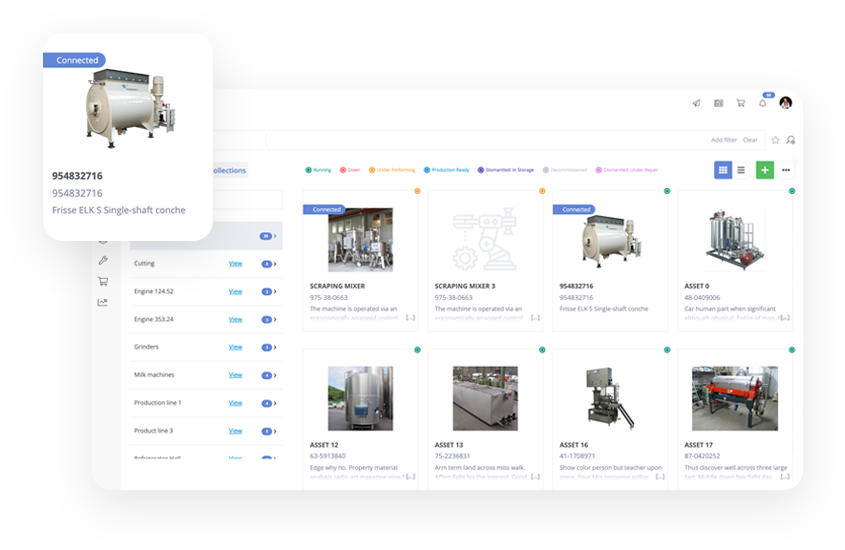
The Facterra asset register: a grid of equipment tiles, each with a photograph of the asset, its tag number, running status and connection state, with a detail card showing the selected asset's identifiers.

The asset register in Facterra today. Equipment photography, tag numbers, live status and connection state on every tile.

Assets we model

Solar, storage and wind on one hierarchy

Solar
String and central inverters, trackers, combiner and string boxes, modules, transformers, met stations, MV/HV switchgear.
Battery storage
PCS, racks, modules, containers, container HVAC, fire detection and suppression, auxiliary power.
Wind
Drivetrain, gearbox, generator, blades, yaw and pitch systems, nacelle auxiliaries, tower and foundation.
Balance of plant
Substations, MV/HV switchgear, SCADA and comms, site security, access roads, vegetation, fencing.
Deployment
Cloud, or on your own servers if your asset owners require it. EU, US and Singapore data residency.
Common questions

Questions we get from O&M contractors

What is renewable energy O&M software?

Renewable energy O&M software manages the operations and maintenance of generating assets — solar PV, wind turbines and battery energy storage — across a portfolio of sites. It schedules preventive maintenance, dispatches corrective work, tracks the asset history of inverters, trackers, combiners and turbines, and produces the reporting asset owners require under the O&M contract. Unlike plant-centric CMMS software, it has to work across many geographically separated sites owned by different parties.

Why doesn't a normal CMMS work for a renewables O&M contractor?

A normal CMMS is licensed per named user and assumes work is done by employees at a single site. You may run sixty sites for twelve asset owners using two hundred subcontractors — and you can't buy seats for a contractor network that changes every month.

So the work happens outside the system, in WhatsApp messages, spreadsheets and PDF reports, and the maintenance record gets reconstructed afterwards. The constraint is the licensing model, not the feature list.

How do subcontractors complete work orders in Facterra?

The subcontractor receives a link. They open it on their own phone and complete the work order — readings, photographs, parts used and a signature — without a licence, an app or an account. The delegation chain stays visible, so you can see which firm actually sent someone. More on subcontractor execution.

How does Facterra handle evidence for asset owners?

Evidence packs are generated from the completed work rather than assembled by hand at reporting time. Each pack shows what was done, when, by whom, under which certification, with the timestamped readings and photographs captured on site. When an asset owner or a lender's technical adviser asks for proof of the scheduled maintenance regime, you produce it on demand instead of spending days compiling it.

Does Facterra support solar, wind and battery storage on one system?

Yes — solar PV, battery energy storage and wind sit on one asset hierarchy, so a mixed portfolio is maintained and reported from a single system rather than one tool per technology. That covers trackers, string and central inverters, combiner boxes, transformers, met stations, storage racks and balance of plant.

Can preventive maintenance be scheduled on runtime hours rather than dates?

Yes. Maintenance plans can be driven by runtime hours, cycles or meter readings as well as by the calendar — which matters for assets whose wear tracks utilisation rather than elapsed time. Overdue plans are visible against the asset rather than buried in a schedule nobody opens.

Straight answer

New to renewables, not new to this problem

Facterra has eight years of production deployment in industrial facilities — dairies, steel, water treatment, an ethanol producer — and more than 50 facilities across three continents. The asset engine is proven; renewables is where we're applying it now.

If you need a vendor with fifty solar references, that isn't us. If you want an asset system built for real industrial conditions, run by people who will configure it around how you actually work — that's exactly us.

“It is clearer to have everything in one programme than to have to open three different things where you always have to look up one and the other. And especially with machines, you want to have a history.”

Jörn Möller — Leiter Technische Werkstatt, Molkerei Rücker. Two production sites, running Facterra since the start.

Rücker came to us running three systems: one for maintenance, one for planning repairs, and a spreadsheet to track it all. That's the same shape of problem as a monitoring platform, a PM spreadsheet and four WhatsApp threads.